The validation chain
By the time a finding carries a severity, it has earned it: detected, corroborated across multiple engines, adversarially probed, assigned a state.
Platforms / Continuous Threat Exposure Management
Most exposure programs drown in their own scanner output: thousands of findings, no proof, and senior engineers triaging spreadsheets instead of fixing risk. VirtueThreatX runs all five Gartner CTEM stages in one workflow and adds the step the industry skips, adversarial validation, so what reaches your team is proven exploitable and worth the interruption. AI and LLM exposure is covered as a first-class attack surface.
Detection only opens the question. A finding is corroborated across engines, adversarially probed, then assigned one of four honest states. Only proven-exploitable exposures reach your engineers, which is what makes the number you report upward defensible.
A candidate finding enters the pipeline.
Cross-engine agreement separates signal from noise.
A production-safe probe proves exploitability.
The finding earns one of four honest states.
Only one state wakes your team
Validated
Proven exploitable; pages on-call with evidence
Validating
In active adversarial probe
Theoretical
Real, but not reachable
Suppressed
Audit trail only
01
Define the estate that matters: the assets, apps, and surfaces where exposure carries business risk.
02
Seedless external attack-surface discovery finds every asset, subdomain, certificate, and shadow service exposed to the internet, and builds the context to understand what each one is and why it matters.
03
Rank by real risk, weighing KEV status, EPSS, and business context over raw CVSS severity.
04
Adversarial, production-safe probing proves what is actually exploitable, the stage most platforms skip.
05
Validated exposures open tickets with an owner and SLA. Remediation is tracked to a proven fix, the fix is retested when anything relevant changes, and monitoring continues. Then the loop starts again.
By the time a finding carries a severity, it has earned it: detected, corroborated across multiple engines, adversarially probed, assigned a state.
Validated (proven exploitable; pages on-call with evidence), Validating (in active probe), Theoretical (real but not reachable), Suppressed (audit trail only). Only Validated wakes your team.
The right scanner goes only to the surfaces where it applies, including web, API, cloud, identity, and AI/LLM. Higher signal, lower cost.
Prompt-injection probing, RAG context fuzzing, shadow-AI discovery, and model-exposure scanning: an attack surface most exposure tools skip.
Re-scans fire on the events that change risk (code pushes, new KEV entries, certificate-transparency logs, cloud changes), and each run reports only what's new.
Over-permissioned roles, leaked credentials, non-human identity sprawl, and IAM relationship walks: the identity attack paths behind most modern breaches.
Architecture
One validation pipeline runs under every engine: detection, corroboration, and adversarial proof share a single evidence trail from first hit to fix.
Discover
Seedless discovery maps everything internet-exposed (assets, subdomains, certificates, shadow services) and monitors it for drift.
Detect
Continuous, event-driven scanning across all nine surfaces with baseline and delta detection: new endpoints, deploys, and drift are caught on change, and findings are corroborated across engines to separate signal from noise.
Validate
Production-safe adversarial probing (BAS) plus LLM triage and KEV cross-reference prove exploitability before a finding ever reaches your queue: the platform's defining step.
Mobilize
Validated exposures auto-open tickets with an owner and SLA, integrate with security operations, and are re-validated on change until proven fixed.
Runs as a continuous exposure-management service alongside our assessment engagements. Adversarial validation is production-safe by design; scope, scan cadence, and data handling are agreed at engagement start, and findings are tenant-isolated.
Per-tenant data isolation; data-handling terms committed in your service agreement. See Trust & Company Facts.
Real screens from a live demo tenant. Client data is redacted; the interface and data model are exactly what your team works in.
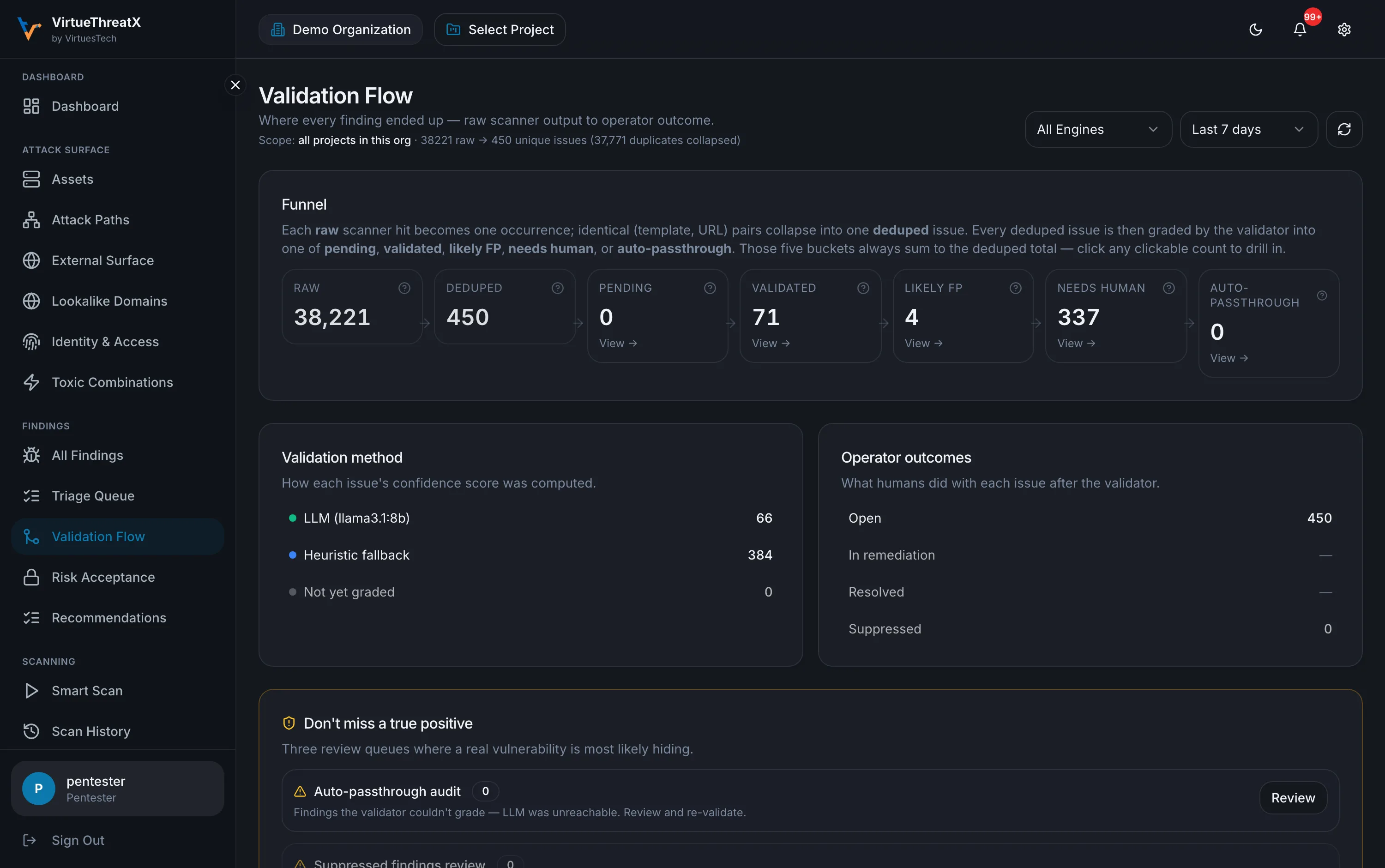
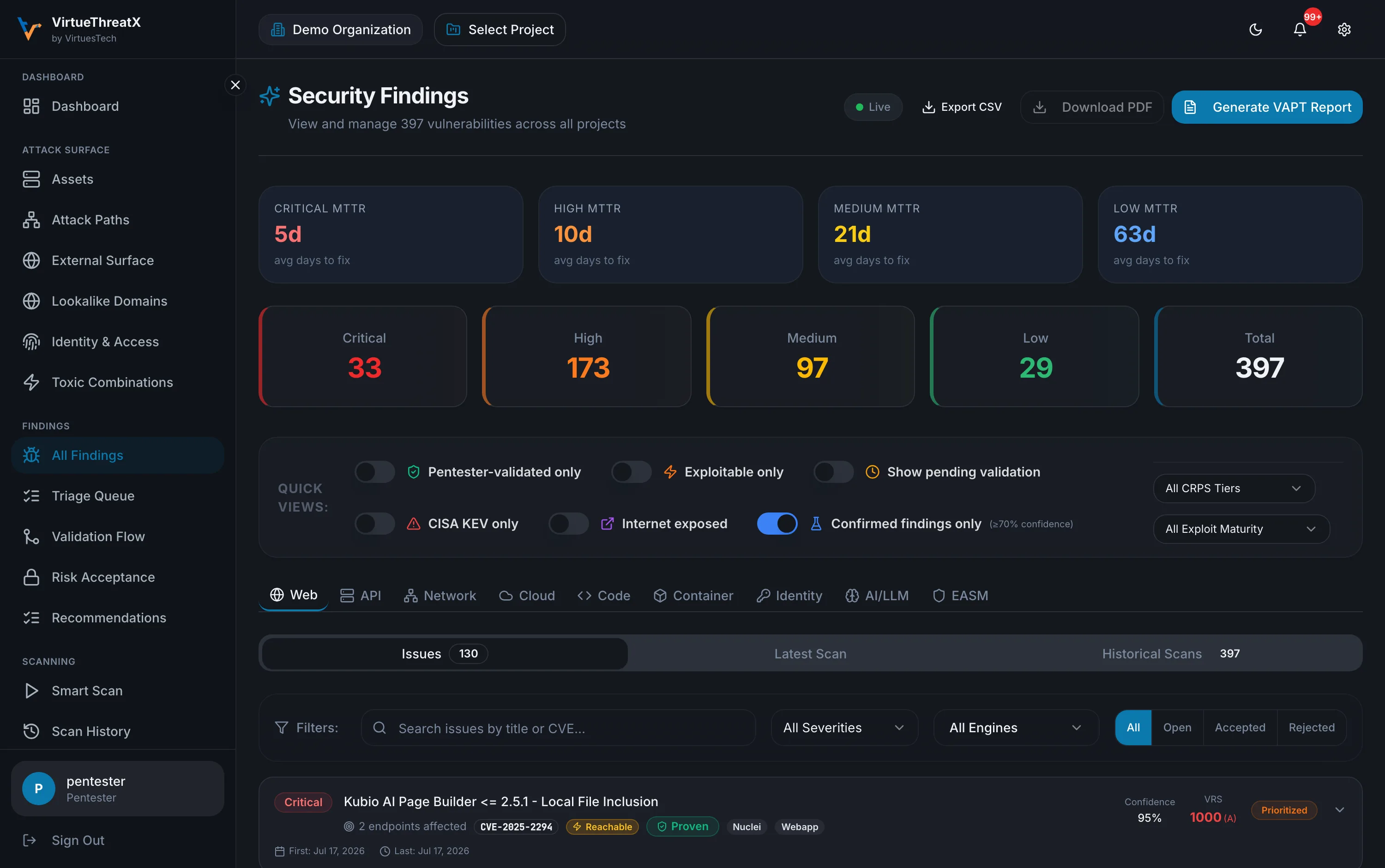
VirtueThreatX powers the attack surface management, exposure management, and security validation services in our cybersecurity practice, and it's the proving ground where findings our red team and pentesters confirm become validated, tracked exposures. Your engineers receive tickets with an owner, evidence, and a retest, never a spreadsheet.
Cybersecurity & Continuous Security Assurance services →A guided session with the engineers who built the platform: how discovery, validation, and prioritization behave against a real attack surface, with your questions answered live.